
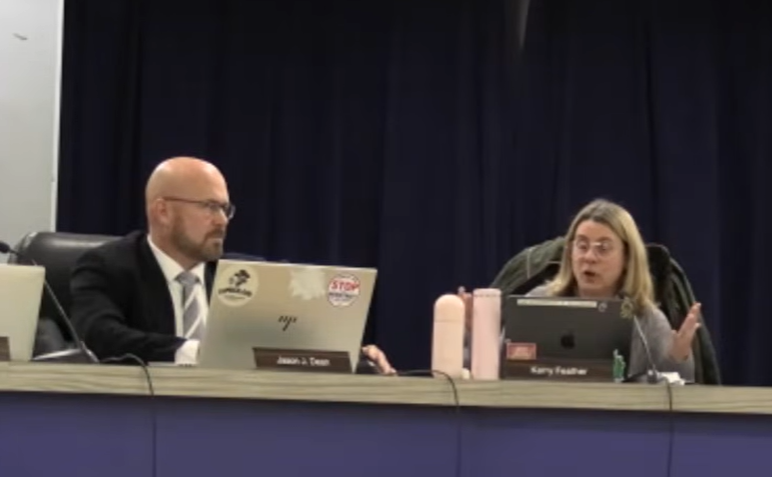
School Committee members Jason Dean and Kerry Feather
By George Sisca II | Sisca News Network
Two weeks ago, Cumberland residents brought the fireworks to the School Committee. Thursday night, committee members supplied the matches.
The latest round of the town's increasingly contentious school redistricting debate featured another proposed map, another collection of frustrated residents and a pointed exchange between committee members Jason Dean and Kerry Feather. What it did not produce was much evidence that Cumberland is any closer to a lasting solution.
And somewhere between Plans A, B and C, the people responsible for deciding where children will attend school appeared to be struggling with a more fundamental question: What problem, exactly, are they trying to solve for the long term?
Thursday's meeting exposed a divide that extends beyond the boundaries on a map. Committee members remain at odds over how to proceed, while residents continue questioning the data, the decision-making process and whether another round of redistricting will accomplish anything beyond postponing the next one.
Feather offered perhaps the evening's most revealing assessment.
"This is a bandaid," she said, referring to the proposed redistricting options.
It was an acknowledgment of what residents have been arguing for weeks. Families are not simply looking for a more agreeable version of the same disruption. They want a solution that does not require another painful exercise in moving children between schools a few years down the road.
The public does not want another Band-Aid. It wants Cumberland to stop cutting.
The district's own published redistricting information acknowledges that another boundary review within five to 10 years is possible, given the town's growth.
That admission raises an uncomfortable question: If Cumberland already recognizes the possibility of revisiting school boundaries within a decade, how much confidence should families place in the durability of the current proposals?
The disagreement between Dean and Feather offered a glimpse into the committee's difficulty answering that question.
At one point, Feather suggested returning to Plan A, an earlier proposal that had already drawn substantial public opposition.
"Well let's just go back to plan A then," she said.
The suggestion came during a contentious exchange with Dean and seemed unlikely to resolve the disagreement. Plan A had already generated significant resistance from residents, making its reintroduction a provocative response to concerns about the newer alternatives.
Dean and Feather were not debating a minor adjustment to a boundary line. Their exchange reflected the broader disagreement over whether the committee should continue refining the existing proposals or reconsider the approach altogether.
Meanwhile, residents continued asking questions that should be central to any responsible redistricting decision.
"Is that based on long term data?" asked a Hines Road resident.
It was a simple question with enormous implications.
Cumberland has spent months discussing school capacities, enrollment projections, transportation efficiencies and neighborhood boundaries. Yet families are still asking whether the proposals reflect the town's future or merely redistribute its present enrollment problems.
A plan that balances enrollment today may accomplish little if projected housing growth, changing demographics or future classroom needs quickly render those boundaries obsolete.
The district says its planning incorporates enrollment projections from the New England School Development Council, along with building capacities and transportation considerations. But providing data and demonstrating how that data supports a particular decision are not the same thing.
Residents are asking for the latter.
"Our kids are not chess pieces," another speaker told the committee.
The statement captured the human cost of a process increasingly dominated by maps, numbers and competing proposals.
Children are not interchangeable units that can be shifted from one building to another without consequences. Friendships, family schedules, transportation arrangements and neighborhood relationships all figure into the equation.
Those concerns deserve consideration, even when the district has legitimate reasons to adjust attendance boundaries.
Another resident, returning to the microphone, described attending three different elementary schools in Cumberland himself.
His experience illustrated that redistricting is hardly a new phenomenon in town. Generations of Cumberland students have experienced changes in school assignments.
But the fact that redistricting has happened before does not establish that every proposed change is necessary or that the district should accept repeated disruption as inevitable.
The question remains whether Cumberland can develop a plan that addresses its enrollment challenges without returning families to the same argument every few years.
Then came a question that reached beyond the maps themselves.
One resident raised Rhode Island's Open Meetings Act, questioning why committee members appeared unable to communicate effectively enough to arrive at a common understanding of the redistricting process.
The concern highlighted a tension inherent in public governance.
Rhode Island's Open Meetings Act is designed to ensure that public bodies conduct public business openly. Its restrictions on discussions involving a quorum are intended to prevent government decisions from being made outside public view.
But those protections can also complicate the work of boards attempting to navigate complicated issues. Members must be careful about how they communicate outside properly noticed meetings, even when their goal is to understand a proposal rather than reach a decision.
That does not mean the committee has violated the law. The resident did not allege a violation.
Instead, his question went to something more basic: How can seven elected officials make an informed collective decision if they are not working from the same understanding of the problem?
The answer cannot simply be another map.
Cumberland has already paid for the services of TransPar, debated the consultant's work and considered multiple boundary configurations. Committee members have questioned the parameters provided to the company and whether its recommendations adequately reflect the town's needs.
The district has also said the School Committee will ultimately make the redistricting decision, with input from district leadership.
That responsibility cannot be delegated to a consultant.
The committee must determine what constitutes an acceptable solution, what trade-offs families should reasonably be expected to make and what evidence supports those decisions.
And it must explain those judgments in a way the public can understand.
Thursday's meeting was not scheduled to produce a final vote. The district has indicated that deliberations will continue, with a final decision anticipated in early 2027.
That leaves time to address the outstanding questions.
But time alone is not a strategy.
Two weeks ago, Cumberland residents arrived with an airing of grievances. Thursday night, the committee demonstrated that some of those grievances are shared, or at least reflected, among its own members.
The maps have changed. The arguments have evolved. The frustrations have become increasingly familiar.
And now even a committee member is calling the proposals Band-Aids.
Cumberland's families have spent months explaining where it hurts. Before reaching for another Band-Aid, perhaps the School Committee should finally explain how it intends to stop the bleeding.
