
Cumberland’s redistricting plan needs more than a map
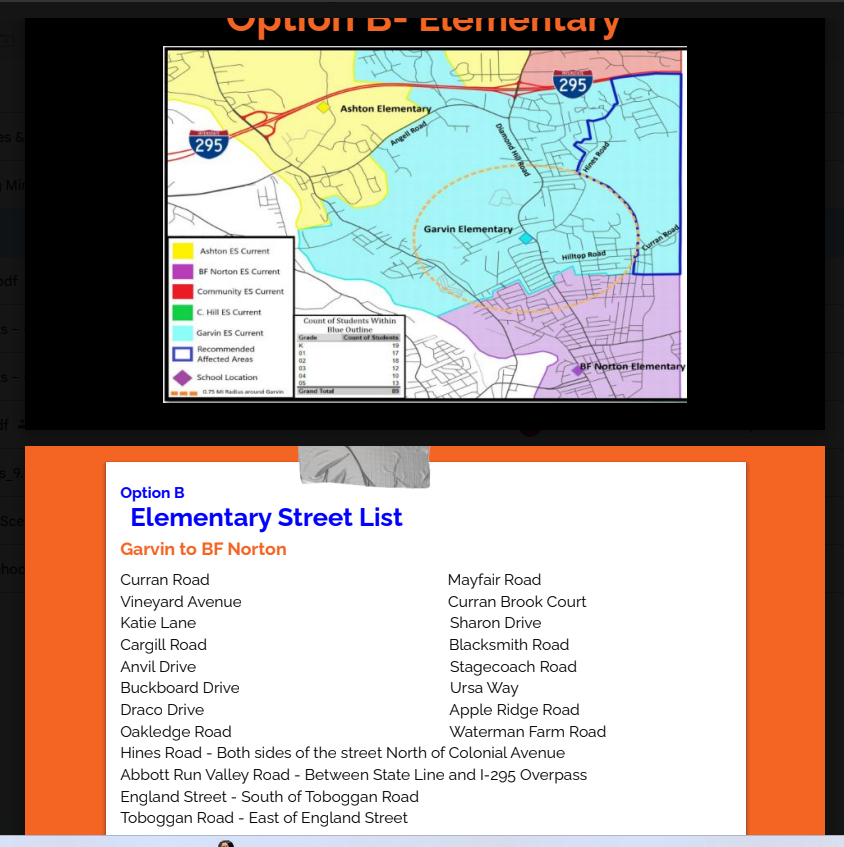
One of the options Transpar proposed
Cumberland’s redistricting plan needs more than a map
By George Sisca II | SNN Commentary
If Cumberland’s kids have to show their work in math class, TransPar should have to show its work on redistricting.
The School Department has a math problem to solve. As of Aug. 27, Garvin Memorial Elementary School had 472 students against a stated capacity of 432. B.F. Norton had 365 students, with its new building expected to accommodate 575. North Cumberland Middle School had 662 students, compared with 481 at Joseph L. McCourt Middle School.
Overcrowded schools do not become less crowded without some sort of change.
The department has published enrollment figures, planning documents and an extensive FAQ. It says TransPar worked with administrators and a Transportation Stakeholder Committee to develop the boundary proposals. The stated priorities include balancing enrollment, using growth projections, keeping boundaries contiguous and avoiding additional transportation costs. The district says an affected street would be included in its entirety, with both sides kept together. This is more information than a bare map and an invitation to trust the experts.
But showing partial work is not showing how the conclusion was reached in a complete way.
The district describes its mapmaking as an iterative process with numerous changes. It says general maps of alternatives can be shared, though some working versions contain sensitive student information. What families need now is a clear comparison of the meaningful choices: how many students each would move, what happens to enrollment by school and grade, which neighborhoods stay together, and why one option was preferred over another. Student information can be protected without making the decision process a mystery.
Transportation presents a sharper test. The district says avoiding added bus costs guided the analysis. It also says the bus company will map the actual routes after a final redistricting decision. That does not prove TransPar’s cost assumption is incorrect; however, it means families and committee members should ask what supports it, and how much a proposed boundary could change a child’s ride even if the number of buses stays the same. The cost of a route and the experience of riding it are two different calculations.
At the Oct. 1 School Committee meeting, members and parents pressed those questions. According to The Local Insider, committee member Jason Dean questioned the instructions given to TransPar, while Andrew Bacon argued that moving students should be a last resort. Bacon suggested examining whether the district could use existing buildings differently, including the former police station and the Transitional Building at Cumberland High School. Superintendent Phil Thornton cautioned that moving adults is easier than moving students.
Bacon’s proposals should be tested, too. A building may exist without having suitable classrooms, available space or a practical way to serve the students who would move there. Converting common areas could affect programs that already use them. If those alternatives are too expensive or disruptive, publish the reasons. If one could relieve overcrowding with fewer student moves, families should see that calculation alongside the boundary maps.
The district’s own Option B street list gives the committee a specific discrepancy to resolve. It proposes moving both sides of Hines Road north of Colonial Avenue from Garvin to B.F. Norton. Both sides of that segment would stay together, but Hines Road as a whole would be split at Colonial Avenue. The district’s FAQ says that when a street is affected by a new boundary, the entire street would be included. Does “entire street” mean the whole road, or only both sides of the selected segment? Families should not have to reverse-engineer that distinction from a street list.
This is about more than whether a line looks awkward on a map. A school change can affect friendships, child care, siblings’ schedules and a family’s daily trip across town. None of that automatically outweighs an overcrowded classroom. It does mean the committee should be able to explain why the benefit of a particular move justifies its cost to the children making it.
I also think we should be careful about treating a change of school as the end of a friendship. Cumberland has excellent public schools, and children have more ways to stay connected than their parents did. When many of us were growing up, a friend who moved away could disappear from our daily lives. Today, kids can call or FaceTime after school and make plans to see each other. That does not replace sitting together at lunch or make a new classroom easy on the first day. But it does mean a boundary change need not erase the relationships children have already built. My concern is whether the new assignment is fair, sensible and worth the disruption, not whether children can form friendships at another Cumberland school.
Cumberland voted 6-1 in September 2025 to engage TransPar for transportation efficiency and redistricting work. The district says it built on a Rhode Island Department of Education transportation study. Its published materials include Transpar’s proposal and updates presented to the committee.
Before judging the value of that engagement, the public should have a straightforward accounting of what the district contracted for, what has been delivered and what it has paid. A proposed price is not a payment record, and an unhappy audience is not, by itself, evidence of a breached contract.
The committee is scheduled to meet Thursday night and may vote on suspending the redistricting plan while it gathers more data and develops a broader plan for community input. A pause could give the district time to answer the questions its own Option B street list raises. It should be used to test the alternatives and explain the eventual choice, not simply to postpone the same argument until another night.
The School Committee has time to get this right. The district says it expects a decision around February or March 2027. That time should be used to put the principal alternatives side by side, explain the transportation assumptions, test the building suggestions and resolve specific boundary complaints while families can still influence the outcome.
I am not asking the committee to promise that no child will change schools. With the enrollment figures the district has published, that would be an easy promise to make and a hard one to keep.
I am asking the adults who may change those schools to do what they expect from every student: put the reasoning on the page, check the answer and show the town their work.
